
When you are moving chilled or frozen products keeping them at the right temperature is not something you can afford to ignore. Have you ever considered what actually keeps the inside of a refrigerated van or truck cold?
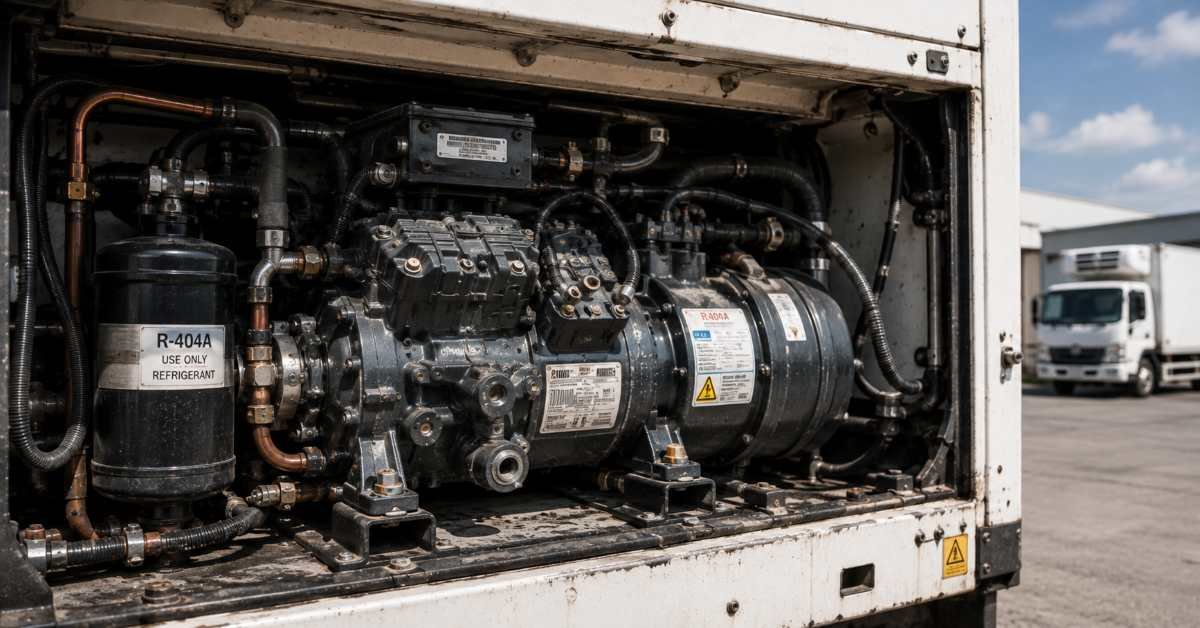
Many parts work together to make this possible. One of the essentials is the refrigeration compressor. It helps keep the refrigerant moving through the system and plays a role in pulling heat out of the cargo area.
At Al Hammad Transport we run chiller vans, freezer vans and refrigerated trucks across Dubai and the UAE. Since our vehicles are used every day for temperature-controlled deliveries we understand that the refrigeration system must be as well cared for as the vehicle itself.
In this article we will explain what a refrigeration compressor does how it works and why it matters when choosing a refrigerated vehicle for your goods.
| Rates | From AED 245/day · Weekly and monthly plans available |
| Coverage | Dubai, Abu Dhabi, Sharjah, Ajman, Ras Al Khaimah, Fujairah, Umm Al Quwain |
| Temperature Range | +2°C to +8°C (chiller) · -18°C to -25°C (freezer) |
| Fleet | Toyota Hiace, Nissan, and Mitsubishi Canter (With or without driver and helper) |
| Certification | HACCP-certified fleet |
These two are often confused, but they serve different purposes:
Knowing your cargo’s exact temperature requirement is the first step to choosing the right vehicle. Rather than assuming every temperature-sensitive job needs the same equipment, we ask about the goods being transported before recommending a vehicle — a customer moving chilled dairy needs something very different from one moving frozen seafood.
What about larger loads? Food distributors, supermarket suppliers and big commercial clients often need to move more than a van can carry. That’s where a refrigerated truck comes in. The basic cooling principle is the same. The larger body means more space for insulation, airflow, door seals and temperature control systems to manage.
We offer chiller vans, freezer vans, refrigerated trucks and chiller trucks across Dubai, Abu Dhabi, Sharjah, Ajman, Ras Al Khaimah, Fujairah, and Umm Al Quwain, on daily, weekly, and monthly rental plans, all with or without a driver.
A refrigeration compressor is the most important component in any cooling system. Its job is to compress and circulate refrigerant gas, driving the cycle that cools the air inside the cargo compartment and removes heat from it.
The refrigeration compressor doesn’t work alone — it’s part of a system that also includes the condenser, expansion device, and evaporator, each with a distinct job:
In simple terms: the refrigeration system pulls heat out of the cargo area and releases it outside, and the refrigeration compressor keeps that process running continuously — even while the vehicle is on the road. That’s why the system needs proper, ongoing attention, and why checking it is a standard part of preparing every vehicle we send out. We’d rather catch a cooling issue before a vehicle is loaded than after it’s on the way to a customer.
No — and this is worth understanding before assuming the worst. Refrigeration systems have several components, and a fault in any one of them can affect performance. Poor cooling could just as easily come from:
Replacing a refrigeration compressor without identifying the actual cause won’t fix a problem caused by something else — which is why our mechanics inspect the full system before deciding what needs repair or replacement.
None of these automatically means the compressor has failed — they simply mean the system should be inspected.

The compressor is critical, but it’s not the only variable:
|
Dubai’s climate raises the stakes. The gap between outside temperature and the required cargo temperature can be extreme, forcing the refrigeration system to work harder just to keep pace. That’s why we look at cooling performance, insulation, and vehicle operation together, not in isolation.
Preventative attention beats waiting for a breakdown. After every delivery, our mechanics inspect:
A refrigerated vehicle has two jobs: reach its destination reliably, and maintain the right conditions for its cargo the entire way. A vehicle can have a perfectly healthy engine and still have a refrigeration fault — or the reverse — so our inspections cover both sides.
We also monitor conditions during the journey. When our vehicles operate with a provided driver and helper, we maintain temperature logs throughout transport where applicable — giving us a documented record and letting our team catch unusual changes in real time, rather than relying solely on the unit’s initial setting.
Even with proper maintenance, the unexpected can happen — and for a temperature-sensitive delivery, waiting for a repair usually isn’t an option. That’s why we maintain standby vehicle arrangements for immediate replacement.
A real example: A delivery services customer originally booked a standard-size chiller van for 5:00 AM at their restaurant. We arranged it the night before. At around 4:30 AM — just thirty minutes before the scheduled operation — their representative called with an urgent request for an additional freezer van. The nearest available unit was more than 100 km away.
Rather than turn the request down, we worked our network immediately, sourced a freezer van from another provider at a higher daily rate, and got it to the customer on time — later swapping in our own freezer van to complete the job. The result: our customer kept its commitment to its own customer without disruption. That’s the kind of outcome that comes from having a strong network and a willingness to find a solution rather than an excuse.
We know our customers are often working against their own deadlines — a delivery going to a restaurant, hotel, supermarket, or catering operation that’s also waiting on the goods. When something goes wrong, our job is to find a solution, not an excuse.
It compresses and circulates refrigerant through the system, helping transfer heat away from the refrigerated cargo compartment.
No. The condenser, evaporator, expansion device, fans, and controls all play important roles alongside it.
Yes — but poor cooling doesn’t automatically mean the refrigeration compressor is at fault. Electrical issues, refrigerant problems, insulation, or door seals can all be the real cause.
A chiller vehicle is built for chilled products (+2°C to +8°C); a freezer vehicle is built for frozen products (-18°C to -25°C).
Rates start from AED 245 per day, with better pricing on weekly and monthly plans.
Dubai, Abu Dhabi, Sharjah, Ajman, Ras Al Khaimah, Fujairah, and Umm Al Quwain.
Toyota Hiace, Nissan, and Mitsubishi Canter vehicles, configured as chiller vans, freezer vans, and refrigerated trucks.
Yes — our refrigerated fleet is HACCP-certified, which matters for food and pharmaceutical customers who need documented cold-chain compliance.
Some of our vehicles are equipped with Thermo King refrigeration units.
Contact us with the type of goods, required temperature, approximate quantity, pickup location, destination, and preferred delivery time, and we’ll recommend the most suitable vehicle.
Most customers don’t think about the refrigeration compressor when booking a refrigerated vehicle — but when you’re transporting temperature-sensitive products, it matters enormously. The refrigeration compressor keeps the refrigeration cycle running; the condenser, evaporator, controls, and insulation all work alongside it to create the conditions your cargo needs.
At Al Hammad Transport, we take a practical approach: we inspect our vehicles, monitor temperature where applicable, run quality equipment including Thermo King units, and back every delivery with driver and helper support, GPS tracking, and standby vehicles.
Whether you need a chiller van in Dubai, a freezer van for frozen products, or a refrigerated truck for a larger shipment — tell us what you’re transporting, where it needs to go, and what temperature it requires. We’ll take it from there.
Al Hammad Transport Chiller Vans | Freezer Vans | Refrigerated Trucks Temperature-Controlled Transportation Across Dubai and the UAE
Author: Iltaf Ali (MD, Al Hammad Transport)